
Why Most Contractors Don’t Have a Marketing Problem — They Have a System Problem
Most contractors believe they need more leads. They spend money on ads, buy lead lists, and chase new opportunities. But when revenue stalls, the problem is rarely at the top of the funnel.
The real issue is structural instability. When a business relies on manual effort instead of a structural contractor marketing system, growth creates friction. That friction eventually fractures the operation.
Why Contractor Marketing Feels Inconsistent
Contractor marketing feels inconsistent because lead generation is disconnected from operational capacity. When visibility outpaces a contractor's ability to capture, follow up, and establish authority, leads slip through the cracks. This structural gap creates unpredictable revenue and forces contractors to compete on price.
To stabilize revenue, the business must shift from random marketing tactics to engineered architecture.
The Contractor Growth System™ (Structural Model)
What Is a Contractor Marketing System?
A contractor marketing system is a structured operational framework that connects visibility, lead capture, follow-up, and authority. Unlike random advertising tactics, a true system ensures that generated demand is systematically captured and converted, protecting profit margins and stabilizing revenue growth.
The architecture below illustrates how these four critical phases must interlock to prevent lead leakage and margin erosion.
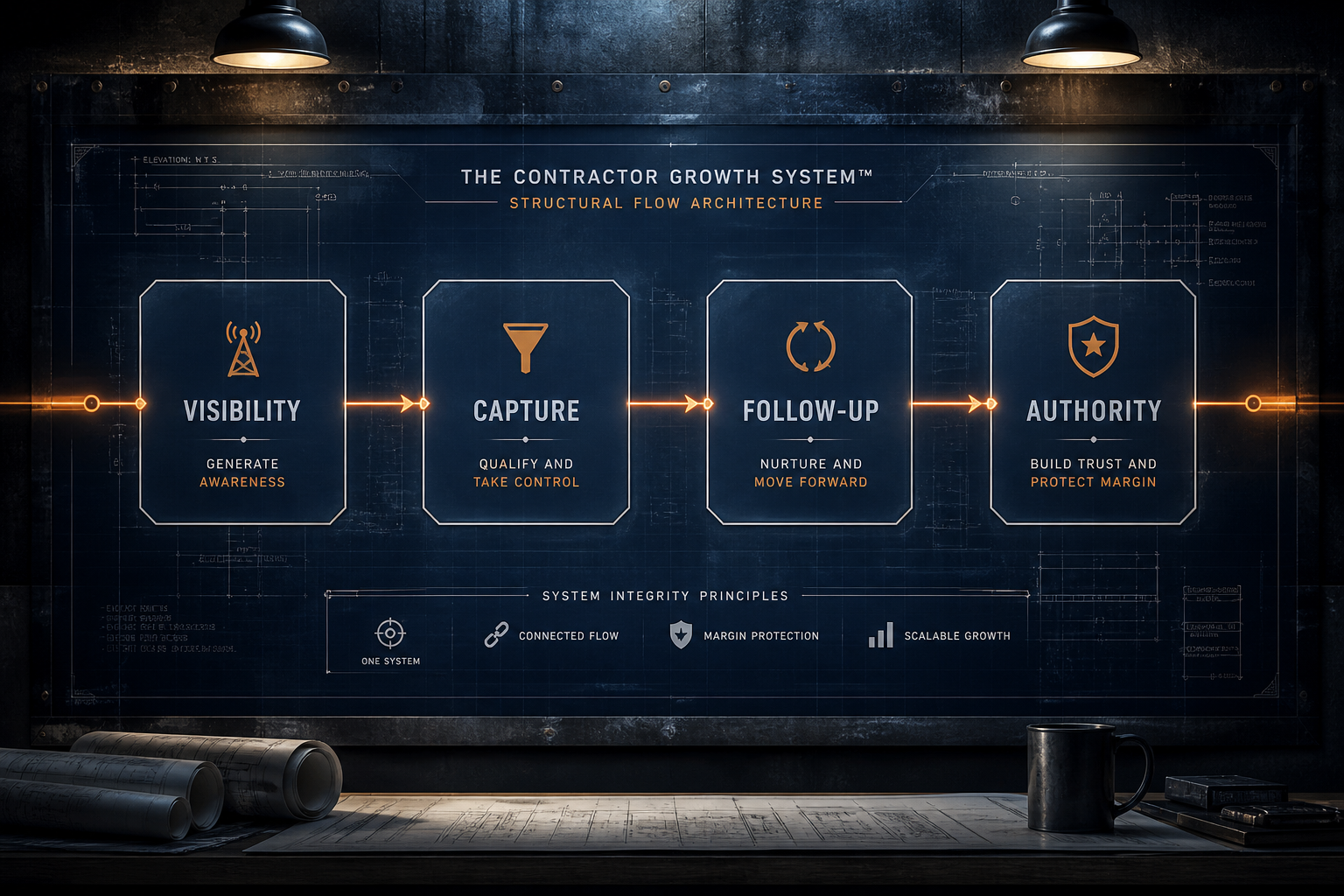
When these four stages align, the business operates with predictability. If any single stage fractures, the entire system loses efficiency and operational strain increases.
The 4 Parts of a Contractor Growth System™
- Visibility: Generates qualified local demand.
- Capture: Secures the inquiry before the prospect leaves.
- Follow-Up: Maintains the connection to prevent lead leakage.
- Authority: Protects the margin by establishing trust prior to the quote.
Visibility generates the demand. Capture secures the inquiry. Follow-up maintains the connection. Authority protects the margin.
When downstream capacity breaks, instability flows backward. If follow-up instability is present, lead capture becomes a bottleneck. If authority is weak, visibility only attracts price-shoppers. You cannot fix a follow-up fracture by pouring more visibility into the top. Ultimately, authority protects margin.
- ▪If lead volume doubled, would response time hold?
- ▪If your estimator stepped away, would follow-up continue?
- ▪If sales increased 20%, would scheduling absorb it?
A system that fails these checks is already fracturing under its current load.
How Structural Breakdown Escalates
System failure does not happen overnight. It follows a predictable, compounding escalation pattern.
- 1InconvenienceA few calls are missed. A follow-up is forgotten.
- 2StrainThe owner works longer hours to catch up on estimates, creating severe contractor operational strain.
- 3InstabilityClose rates drop from 40% to 28%. Crews sit idle because jobs aren't closing fast enough.
- 4Financial RiskMargin compresses by 3 to 5 points just to win bids and keep the schedule full. Leadership capacity is completely lost to putting out fires.
I saw this firsthand managing 30 workers across multiple cities. When the schedule outpaced the structure, the entire operation became fragile. Effort could not outwork a broken system.
To identify where the framework is vulnerable, it must be subjected to controlled stress.
The Growth Stress Test Model™
This model visualizes how pressure exposes the true load-bearing capacity of your business.
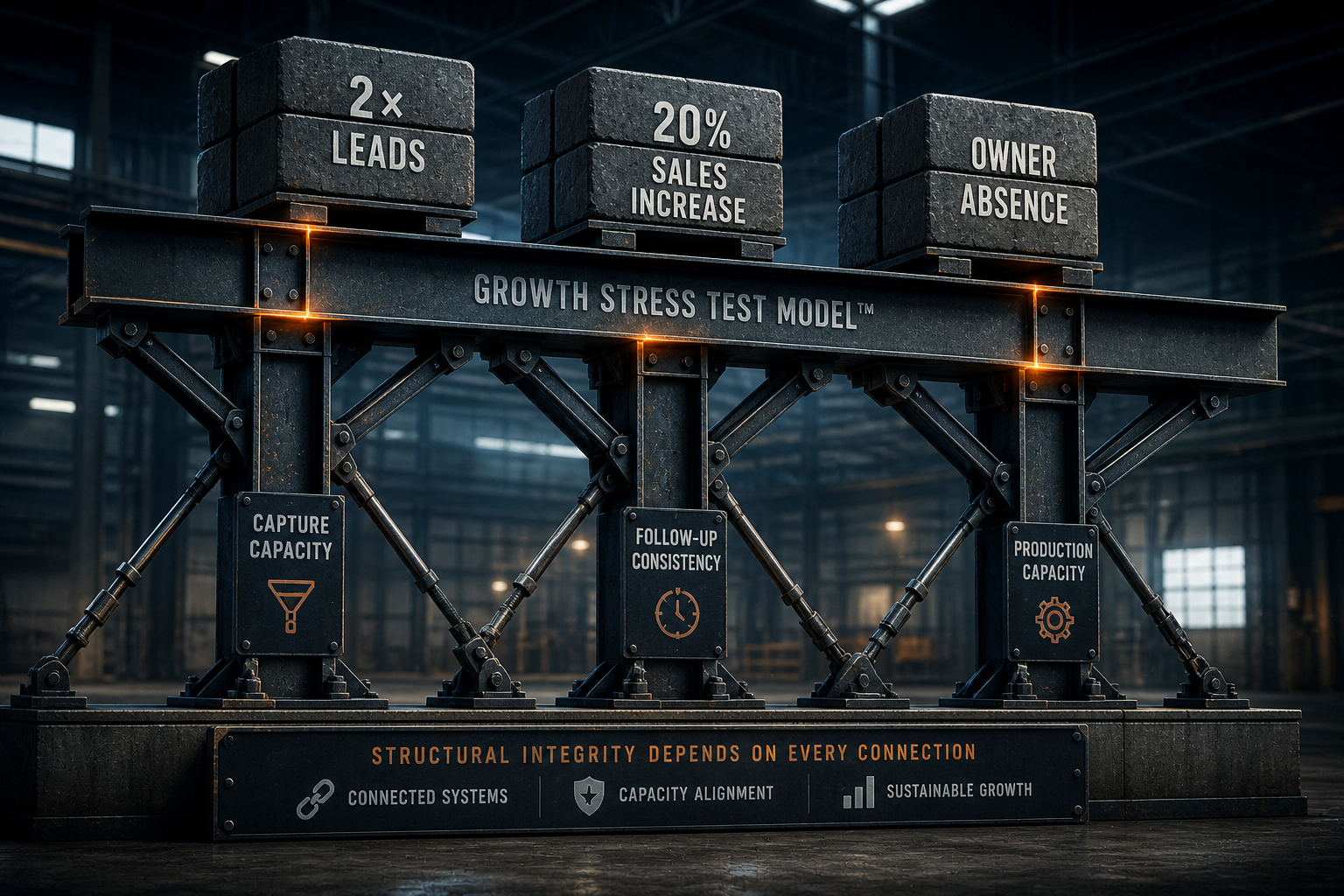
A strong contractor growth framework can handle pressure. A weak system collapses under it. You can test your operational structure using three simple scenarios.
2× Lead Volume
If your lead volume doubled tomorrow, would your revenue double? For most, the answer is no. Response times would drop, follow-up would fail, and close rates would plummet.
20% Sales Increase
If you sold 20% more jobs this month, could your crews deliver without chaos? Without operational structure, a sales spike creates a fulfillment nightmare. Quality drops and margins shrink.
Owner Absence
If the owner steps away for two weeks, does the pipeline still move? If the answer is no, you do not have a system. You have an owner-dependent job. These tests expose where the structure is actually failing.
When a system fails these tests, it reveals the ultimate ceiling on the company's growth.
The Structural Breaking Point
The breaking point happens when effort can no longer compensate for inefficiency. The owner hits a physical limit.
At this stage, contractors often blame the market, the leads, or the competition. They try to lower prices to force growth. But lowering prices only accelerates the collapse.
You cannot out-work a structural deficit. When the system breaks, the only solution is to rebuild the architecture holding the business together. A clear lead flow breakdown is required to identify the exact point of failure.
Rebuilding that architecture requires adhering to fundamental truths about how predictable businesses operate.
Principle Clarity
The following blueprint defines the unyielding rules of structured contractor growth.

These principles are not optional. They dictate whether a business scales or fractures.
Margin is protection.
Structure prevents strain.
Systems create stability.
Growth without structure creates collapse.
Frequently Asked Questions
These questions surface where structural instability usually hides.
Why do contractors struggle with lead quality?
Contractors struggle with lead quality when their visibility lacks authority. If a business only competes on availability or price, it attracts price-shoppers. Building authority before the quote filters out poor-fit prospects and ensures that inquiries are pre-framed for value, not just the lowest bid.
How does follow-up affect profit margins?
Inconsistent follow-up forces contractors to constantly acquire new leads to maintain revenue. This increases acquisition costs and creates scheduling gaps. A structured follow-up process prevents lead leakage, stabilizes the pipeline, and allows the business to hold its pricing without discounting out of desperation.
What happens when a contractor grows too fast?
Rapid growth without underlying structure causes operational collapse. When sales outpace production capacity, quality drops, timelines extend, and leadership is forced into constant firefighting. Sustainable growth requires engineered systems that can handle increased volume without breaking the customer experience or exhausting the crew.
Why is relying on referrals dangerous for builders?
Referrals are highly qualified but entirely unpredictable. Relying solely on word-of-mouth removes a contractor's control over their pipeline volume and project timing. A structured growth system supplements referrals with predictable, controlled demand, ensuring the schedule remains full even during seasonal dips or economic shifts.
How can a contractor stop competing on price?
To stop competing on price, a contractor must shift the conversation from cost to trust. This is achieved through strong authority positioning—using case studies, professional presentation, and clear communication. When a prospect trusts the structural integrity of the business, price becomes a secondary factor.
What is the biggest bottleneck in a contracting business?
The owner is typically the largest bottleneck. When a business relies on the owner's memory for follow-up, estimating, and project management, it cannot scale past their physical capacity. Implementing structured systems removes the owner from daily friction, allowing the business to operate independently and efficiently.
Why do marketing agencies fail contractors?
Most marketing agencies focus exclusively on visibility and lead generation, ignoring what happens after the phone rings. If a contractor lacks the internal structure to capture and follow up on those leads, the marketing budget is wasted. Growth requires a complete system, not just top-of-funnel traffic.
How do you measure contractor system stability?
System stability is measured by close rate consistency, margin protection, and operational calm. If revenue requires constant owner intervention, emergency discounting, or chaotic scheduling adjustments, the system is unstable. A stable system produces predictable revenue with protected margins, regardless of minor market fluctuations.
About the Author
Tony Aponte has over 20 years of construction operations experience and 15+ years building contractor growth systems. His frameworks are built from firsthand contractor field experience and structured system implementation.