

Clarity does not become valuable when it sounds good. It becomes valuable when the business can operate from it.
Many contractors think they have a communication problem when estimates slow down, follow-up gets inconsistent, or jobs start moving with missing details. The deeper issue is usually structural. The business does not have a clear operating standard for what it sells, who it serves, how decisions get made, and how work moves from estimate to production.
That gap looks small at first. Then it starts costing margin, crew time, and leadership capacity.
This is where the Clarity Operating Standard matters.
The Clarity Operating Standard
The Clarity Operating Standard is a contractor growth framework that defines the work, the customer, the decision path, and the handoff structure before confusion reaches the field. It protects margin by turning unclear movement into controlled operating flow.
In a fixed-overhead service business, clarity is not optional. Payroll, trucks, admin time, insurance, and production capacity keep costing money whether the work flows cleanly or not.
When clarity is weak, the business pays for confusion in real time.
What Business Clarity Really Means
Business clarity is not branding language. It is operating control.
A contractor can have a clean website, a strong reputation, and steady lead flow, but still lose stability if the business is unclear about what work fits, what work should be rejected, how jobs are estimated, and who owns the next step.
That is why clarity must be built into the business, not just written into the marketing.
At an operating level, clarity answers four questions:
- Define the work
- Define the customer
- Define the decision path
- Define the handoff structure
When those answers are clear, the business gets faster. Estimates are cleaner. Sales follow-up becomes more consistent. Production knows what is coming. Leaders stop becoming the fallback for every unresolved question.
When those answers are unclear, the company runs on memory, personality, and constant correction.
That is not scalable. It is strain disguised as activity.
The Clarity Operating Standard
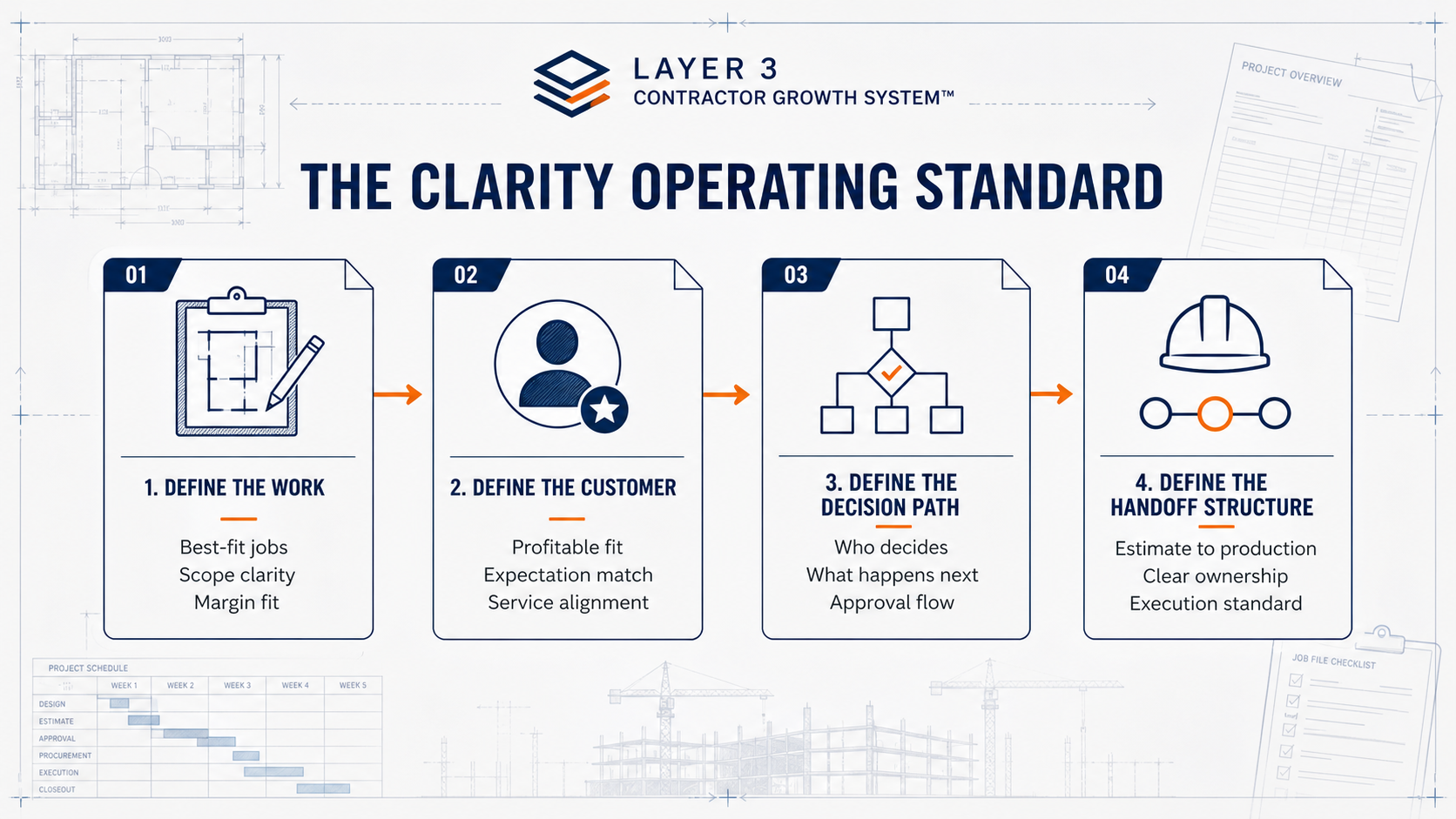
The Clarity Operating Standard defines the work, customer fit, decision path, and handoff structure before confusion reaches production.
The Clarity Operating Standard has four parts.
1. Define the work the business is built to win.
Not every job is a good job. Some projects create too much coordination, too much risk, too many unclear expectations, or too little margin. If the company does not define the work it is built to win, the estimating process starts treating every opportunity like it deserves the same attention.
That creates drag before the job is ever sold.
2. Define the customer the business can serve profitably.
A profitable customer is not only someone who can pay. A profitable customer fits the service model, timeline, communication process, scope structure, and delivery capacity of the business.
When the wrong customers make it through the pipeline, the cost does not always show up in the estimate. It shows up later through extra calls, unclear expectations, slow approvals, delayed starts, and field-level frustration.
3. Define the decision path.
Every business needs a clear way to decide what happens next. Who qualifies the lead? Who approves the estimate? Who follows up? Who confirms scope? Who decides whether a job moves to scheduling?
If decisions move through whoever is available, the business slows down under pressure.
4. Define the handoff structure.
The handoff from estimate to production is where many contractors lose control. Sales may understand the job one way. The customer may expect something else. The field may receive only part of the information needed to execute cleanly.
A weak handoff turns yesterday’s sale into tomorrow’s rework.
The standard is simple: the job should not move forward until the decision, owner, next step, deadline, and execution standard are clear.
Where Clarity Breaks Down
Confusion starts as a small inconvenience, but it creates strain when decisions, job details, and ownership are unclear. If it continues, production becomes unstable, margins compress, crews wait, and the owner gets pulled back into daily chaos.
That is how instability starts.
I have seen this in contractor operations firsthand. A company believes it has a sales problem, but once the workflow is examined, the real issue is that every job takes a slightly different path after the estimate.
One estimate is followed up by the owner. Another is followed up by the office. Another sits for days. One job is handed off with clear scope. Another reaches the field with missing details. One customer gets a clean next step. Another has to ask what happens next.
The team stays busy, but the business gets weaker.
That is the hidden cost of unclear structure.
How Confusion Turns Into Cost
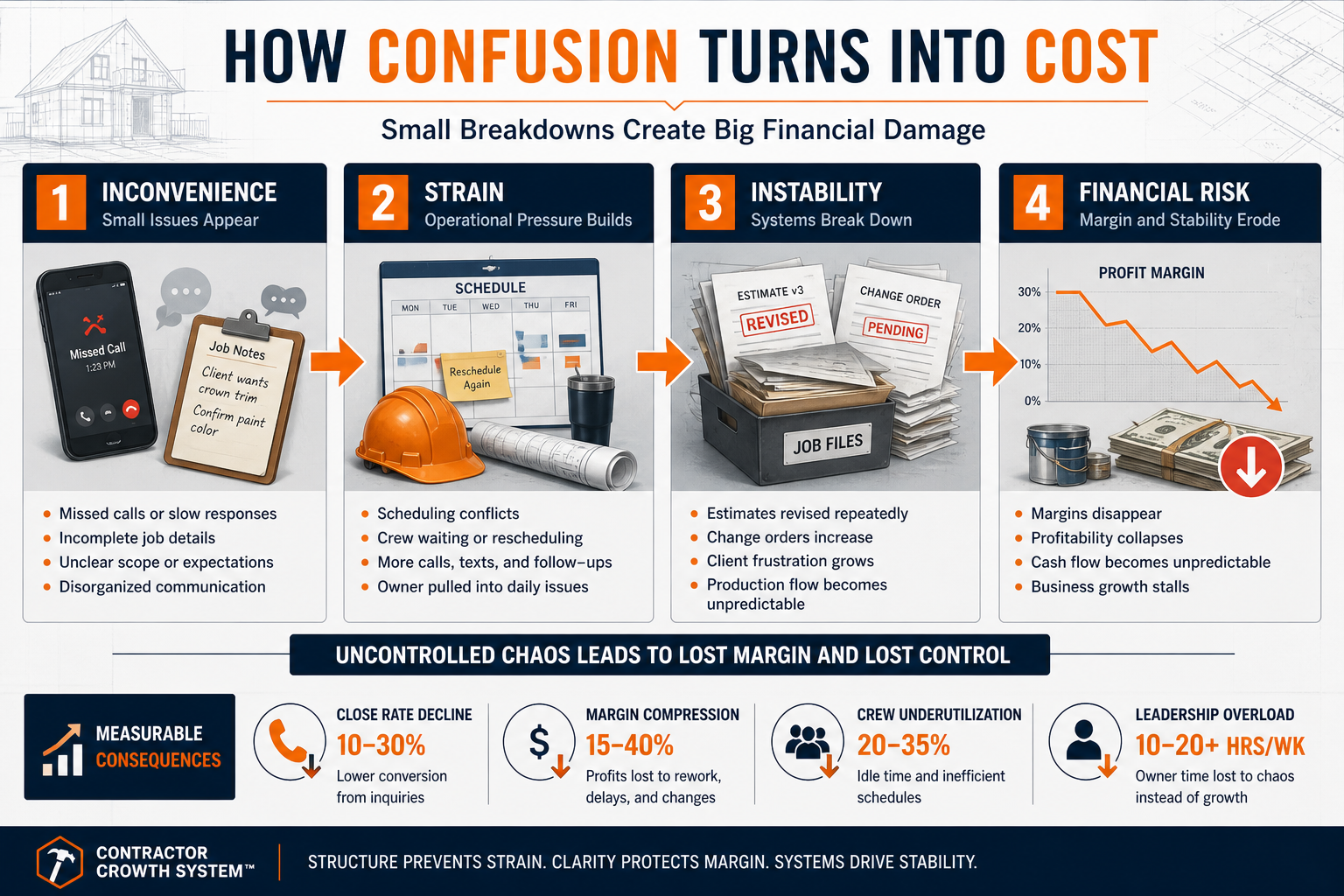
Confusion becomes expensive when small breakdowns turn into operational strain, instability, and financial risk.
Confusion always escalates.
First, it is an inconvenience.
People ask more questions than they should. Follow-up takes longer. Small details are clarified through text messages, phone calls, and repeated conversations. Leaders write it off as normal business noise.
Then it becomes strain.
Crews wait for answers. Office staff spend more time chasing status. Estimators revise work that should have been scoped correctly the first time. Leaders lose time to preventable decisions instead of protecting margin, capacity, and production flow.
Then it becomes instability.
The business starts relying on memory and rescue. Jobs move without clean handoffs. Follow-up becomes reactive. Scheduling gets tighter. Customer expectations drift away from what the field can deliver.
At that point, the business is no longer operating from structure. It is operating from correction.
Then comes financial risk.
A close rate that falls from 40% to 28% forces the business to bid more work just to produce the same booked revenue. A 3–5 point margin compression can erase the profit from a busy month. Crew underutilization increases overhead pressure because labor and fixed costs keep running while production slows.
- →A close rate that falls from 40% to 28% forces the business to bid more work just to produce the same booked revenue.
- →A 3–5 point margin compression can erase the profit from a busy month.
- →Crew underutilization increases overhead pressure because labor and fixed costs keep running while production slows.
This is why clarity protects margin.
It reduces the cost of preventable confusion before that confusion reaches the field, the customer, or the bank account.
How Leaders Build Clarity Into Daily Work
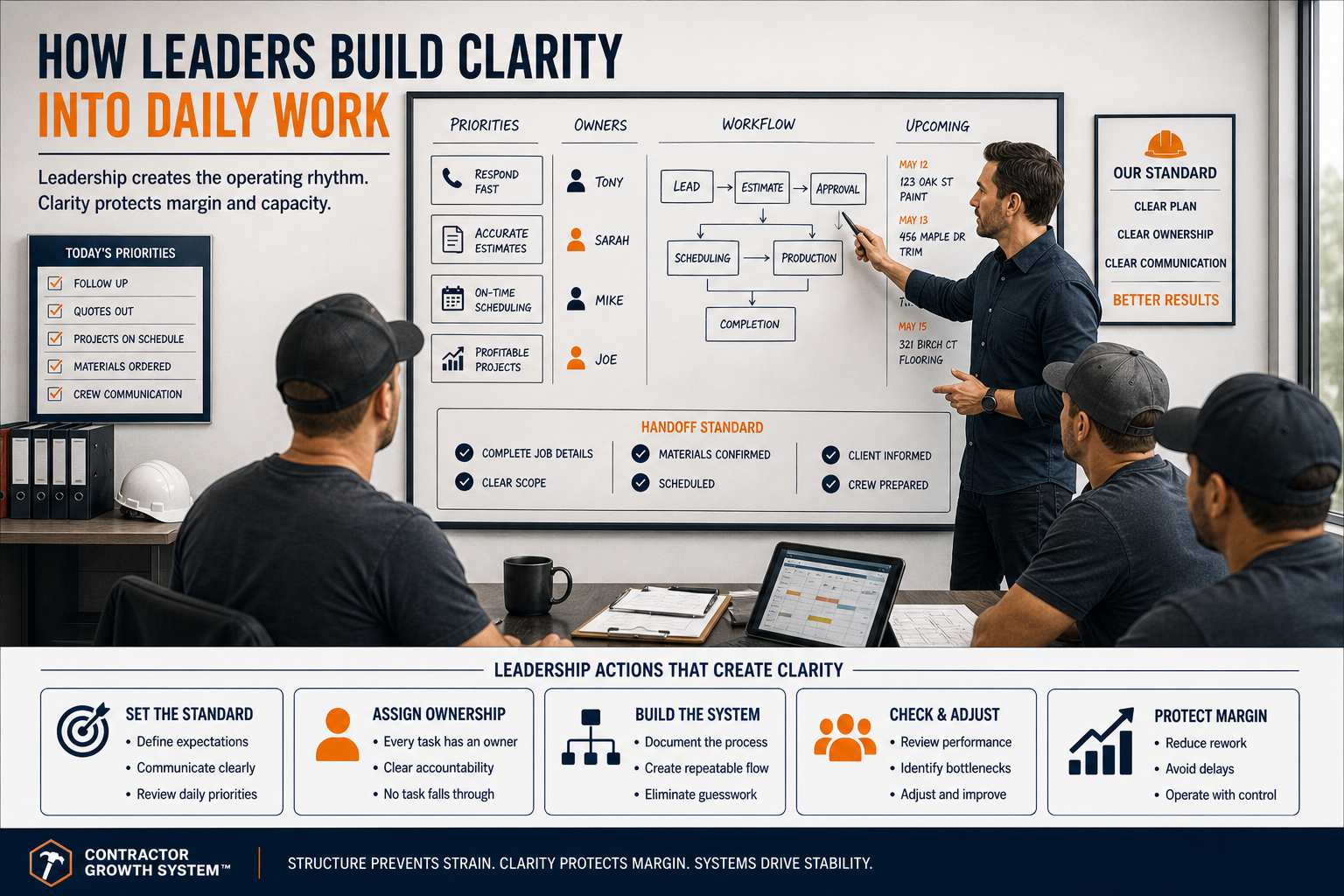
Leadership creates clarity by setting standards, assigning ownership, building repeatable flow, and protecting margin.
Clarity does not hold because a leader explained something once.
It holds because the business repeats the same operating standards until the team can work from them without constant correction.
Leaders create clarity by making priorities visible.
If the team does not know what matters most right now, every person starts making decisions from a different standard. Sales may chase volume. Production may protect schedule. The office may focus on speed. The owner may care most about margin.
None of those priorities are wrong by themselves. The problem is that they conflict when they are not ranked.
Leaders also create clarity by defining what good work looks like before work begins.
A clear estimate should not only state the price. It should clarify scope, expectations, exclusions, next steps, timing, and decision points. A clear handoff should not only notify production that a job sold. It should transfer the information needed to protect the customer experience and the margin.
Daily clarity also requires ownership.
Every task needs one owner. Every handoff needs one route. Every decision needs a timing standard. If responsibility is shared too loosely, accountability disappears into the gap between roles.
That is when the owner becomes the backup system.
And when the owner becomes the backup system, leadership capacity starts collapsing.
How to Measure Clarity
Clarity can be measured by watching where work stops.
- If work stops because nobody knows who owns the next move, the system is unclear.
- If estimates slow down because scope keeps changing, the system is unclear.
- If follow-up depends on memory instead of rhythm, the system is unclear.
- If crews wait for answers that should have been handled before production, the system is unclear.
- If leaders keep answering the same questions every week, the system is unclear.
A stable operation does not depend on repeated explanation. It depends on visible standards.
Contractors can measure clarity by tracking a few simple signals:
- How many estimates require revision because the original scope was incomplete?
- How many sold jobs reach production with missing details?
- How often does follow-up happen late or inconsistently?
- How much leader time is spent clarifying work that should already be defined?
- How often do crews wait because decisions, materials, or approvals were not ready?
These are not soft indicators. They are operating signals.
When these signals rise, margin is usually already under pressure.
Final Principle
Clarity is not a motivational idea. It is a structural requirement.
A contractor cannot protect margin, speed, customer trust, and leadership capacity while the business runs on unclear decisions and weak handoffs.
The Clarity Operating Standard gives the business a stronger base. It defines the work, the customer, the decision path, and the handoff structure so execution can move without constant rescue.
When clarity is built into daily operations, the company becomes easier to run. Estimates get cleaner. Follow-up gets steadier. Production becomes more predictable. Leaders regain capacity.
Growth without clarity creates strain.
Growth with clarity creates control.
That is the advantage.
Frequently Asked Questions
What does business clarity mean for contractors?
Business clarity means the company knows what work it is built to win, which customers it can serve profitably, how decisions move, and who owns each handoff before the job reaches production. Without that clarity, the owner becomes the system. Every missed detail, unclear expectation, and delayed decision moves back to leadership.
Why does lack of clarity hurt contractor margins?
Lack of clarity creates rework, scheduling gaps, missed expectations, and production delays. Those problems may look small at first, but they increase labor drag, reduce close rate, and compress margin. When confusion keeps repeating, the business pays for it through lost time, weaker handoffs, and unstable production flow.
What is the Clarity Operating Standard?
The Clarity Operating Standard is a contractor growth framework that defines the work, the customer, the decision path, and the handoff structure before confusion reaches the field. It gives the business a cleaner operating path from estimate to production.
How does clarity protect leadership capacity?
Clarity protects leadership capacity by reducing repeated decisions, unclear ownership, and preventable production interruptions. When the system is clear, the owner does not have to personally solve every breakdown. Leadership can focus on direction, standards, and stability instead of daily rescue.
How does clarity improve production handoffs?
Clarity improves production handoffs by making sure scope, expectations, ownership, and next steps are defined before the job moves forward. A clean handoff reduces crew confusion, customer frustration, rework, and last-minute decisions in the field.
When should a contractor review their clarity standard?
A contractor should review the clarity standard when close rates decline, margins compress, crews wait for direction, or the owner keeps getting pulled into avoidable issues. Those are signs that the operating structure is no longer clear enough to protect growth.
Explore Further
Tony Aponte
Founder | Contractor Growth System™
Tony Aponte helps contractors build structural stability inside their marketing, lead flow, and operations. His work focuses on protecting margin, restoring leadership capacity, and eliminating growth-driven chaos through engineered systems.